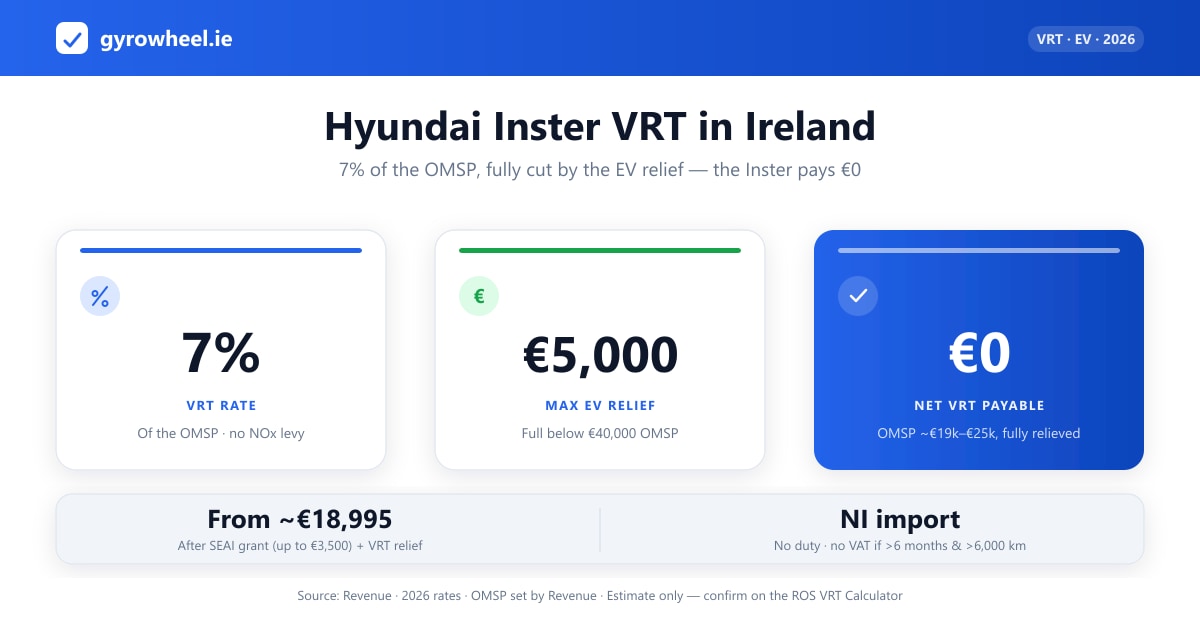
VRT applies to a Hyundai Inster in Ireland, but it is charged at 7% of the OMSP and then fully cancelled by an EV relief of up to €5,000 — so a Hyundai Inster pays €0 net VRT. As a battery electric vehicle, the Inster sits in the lowest 7% band, pays no NOx levy, and its OMSP stays far below the €50,000 cap where the relief would taper.
This matters when you are pricing a new Inster or weighing up an import, because listings that promise "€0 VRT to pay" are accurate but rarely explained. Revenue (the Office of the Revenue Commissioners) sets the rates and is the final authority on the amount due. This guide turns the rule into a clear answer, with one fully worked example for the Inster and the real import picture from Northern Ireland versus Great Britain.
Do you pay VRT on a Hyundai Inster in Ireland?
You do pay VRT on a Hyundai Inster, but it is not an exemption: Revenue charges 7% of the OMSP and then subtracts an EV relief of up to €5,000, which cancels it entirely — the net VRT is €0. Before estimating the amount, the first myth to clear up is that electric cars are simply tax-free — they are not.
Relief, not exemption: the distinction that matters
The key distinction is that VRT is calculated, then reduced — not waived outright. Revenue treats a battery electric vehicle like any other car for the initial charge, applies the rate, and only then subtracts the relief (Revenue, 2026). For an affordable car like the Inster the result is the same as an exemption — €0 owed — but the mechanism still matters: the figure that reaches your bill is a relieved charge, not a blanket waiver.
Calling EVs "exempt" is exactly the assumption that leads to confusion at the NCTS. The correct framing is VRT relief, capped at €5,000 for category A vehicles, and for the Inster that cap comfortably swallows the whole charge.
Why the Inster is taxed at 7% with no NOx levy
The VRT rate on a Hyundai Inster is 7% of the OMSP, the lowest band in the system, because VRT for a passenger car is set by CO2 emissions and a battery electric vehicle emits none. With zero tailpipe CO2, the Inster lands in the bottom band, which carries the 7% rate (Revenue, 2026).
The same zero-emissions logic removes the second component of VRT. The NOx levy is charged on a car's nitrogen-oxide emissions, and a pure BEV like the Inster produces none — so the NOx charge is €0 (Revenue). That makes the formula refreshingly short:
VRT = (OMSP × 7%) + €0 NOx − EV relief (up to €5,000)
Every figure below flows from that single line.
How the EV VRT relief works: OMSP and the €50,000 cap
The EV relief is worth up to €5,000 in full below €40,000 OMSP, tapers between €40,000 and €50,000, and disappears above €50,000 — and the Hyundai Inster's low OMSP keeps it firmly in the full-relief band. Now that VRT is clearly "charged then cancelled", everything turns on a single figure — the OMSP Revenue assigns to your Inster.
What is the OMSP and how does Revenue set it?
The Open Market Selling Price is the price Revenue considers the car would sell for retail in Ireland, including all taxes — not the price you actually paid abroad or a configurator base figure. Revenue maintains its own valuations, so a cheap private purchase does not lower your OMSP.
This matters because both the relief and the €50,000 cap are measured against the OMSP, never against your invoice. For the Inster, even a top-spec version stays well under €40,000, so the full relief always applies — but the only figure that is binding is the one behind the ROS VRT Calculator.
The three relief bands — and where the Inster sits
Once you know the OMSP, the relief follows three clear bands. The table below sets out what each means for any BEV taxed at the 7% rate, with the Inster sitting squarely in the first row.
| OMSP band | VRT rate | Relief applicable | Estimated net VRT |
|---|---|---|---|
| ≤ €40,000 (the Inster) | 7% | Up to €5,000 (full) | €0 |
| €40,000 – €50,000 | 7% | Tapered (partial) | €0 or small partial |
| > €50,000 | 7% | None | Full 7% VRT due |
In practice, the Hyundai Inster — with an OMSP of roughly €19,000–€25,000 — never leaves the first band. The €5,000 relief is far larger than the 7% charge on such a low OMSP, so the net VRT is always €0. Only a far more expensive EV ever reaches the taper or the cap.
How much VRT will you pay on a Hyundai Inster? A worked example
For a Hyundai Inster with an illustrative OMSP of €19,500, the VRT at 7% works out at about €1,365 — but the €5,000 relief absorbs it completely, leaving €0 to pay. The relief bands become far clearer applied to a real car, so here is the Inster worked from end to end. (The OMSP below is illustrative; only Revenue's valuation is binding.)
Step-by-step: OMSP → 7% → relief → €0
Take a Hyundai Inster with an estimated OMSP of €19,500. The calculation runs as follows:
- Step 1 — OMSP: €19,500 (Revenue valuation, illustrative — not your purchase price).
- Step 2 — VRT at 7%: €19,500 × 7% = €1,365.
- Step 3 — NOx levy: €0 (battery electric, no NOx emissions).
- Step 4 — Apply relief: relief available is up to €5,000, which fully covers the €1,365.
- Step 5 — Net VRT payable: €0.
Even at the upper end of the Inster's range — an OMSP nearer €25,000 — the 7% charge would be about €1,750, still far below the €5,000 relief. The Inster simply cannot generate a VRT bill the relief fails to cover, which is what makes it one of the cheapest EVs to register in Ireland.
VRT relief vs the SEAI grant in the headline price
The price you see advertised already bakes in two separate supports. DC EV listed the entry-level Inster Signature (42 kWh) from around €18,995 "after the SEAI grant and VRT relief" (DC EV, 2025), and Bolands quoted roughly €19,595 (2026, indicative).
That headline reflects both the SEAI Purchase Grant (up to €3,500) and the VRT relief, which are distinct schemes with their own conditions. The grant reduces the purchase price at the point of sale; the relief reduces the VRT to €0. They are applied at different stages, so check each scheme's current eligibility rules.
Importing a Hyundai Inster: Northern Ireland vs Great Britain
A used Hyundai Inster imported from Northern Ireland can carry €0 VRT, NOx, VAT and import duty, whereas one bought in Great Britain adds 23% VAT and 10% import duty on top of the (already relieved) VRT. If you are not buying new from a Hyundai dealer but importing, the origin of the car changes the total bill far more than the VRT itself.
From Northern Ireland: the 6-month / 6,000 km rule
Northern Ireland sits inside special arrangements, so an Inster already in free circulation there carries no import duty. VAT only becomes due when the vehicle qualifies as a new means of transport — that is, under 6 months old or under 6,000 km. A used Inster that clears both limits therefore avoids VAT and duty, while its VRT is relieved to €0.
| Charge | Northern Ireland (used Inster) |
|---|---|
| VRT | €0 (relieved) |
| NOx levy | €0 (BEV) |
| Import duty | €0 |
| VAT | €0 if over 6 months and over 6,000 km |
This is exactly the case behind a real listing: a 2025 Inster (49 kWh) from Tyrone advertised at £17,991 with "€0 VRT, no NOx, no VAT, no import duty" (DoneDeal, 2025) — accurate because it was a used car clearing the thresholds.
From Great Britain: 23% VAT + 10% duty
An Inster bought in Great Britain is treated as a full third-country import post-Brexit, so the extra charges stack quickly. On top of the (relieved, €0) VRT you add 10% import duty and 23% VAT on the value of the car (Revenue). On a small EV these add several thousand euro, which often wipes out the saving that made the British listing attractive. The VRT relief still applies, but it does nothing to offset the VAT and duty.
Registering your Inster: NCTS, the 30-day deadline and the VRT calculator
You must register an imported Hyundai Inster within 30 days of its arrival in Ireland at an NCTS appointment, after estimating the amount on Revenue's official ROS VRT Calculator (Revenue / ROS / NCTS). Once you know the VRT will be €0, registration with the NCTS is the step that makes the import official — and it is still mandatory even when nothing is owed. If you are weighing up other models too, our overview of VRT on electric cars in Ireland walks through the same rules across the wider EV market.
The sequence is fixed, and the clock starts the day the car lands:
- Estimate the VRT on the ROS VRT Calculator — for an Inster it will confirm €0.
- Book an examination appointment with the NCTS as soon as the car arrives.
- Bring the vehicle for physical examination with its supporting documents.
- Complete registration within 30 days of arrival to avoid penalties.
Missing the 30-day window is what triggers penalties, so book the appointment early rather than waiting for paperwork to be perfect.
Frequently asked questions
The most common Inster VRT questions cover whether EVs pay VRT at all, the real €0 Northern Ireland imports, stacking the SEAI grant, and when the relief ends. Here are quick answers to the points buyers ask most once the main calculation is clear.
Do you pay VRT on electric vehicles in Ireland?
In principle, yes — VRT is charged on electric vehicles at 7% of the OMSP, the lowest band, with no NOx levy (Revenue). But an EV relief of up to €5,000 is then deducted, so affordable BEVs such as the Hyundai Inster end up paying €0. The relief is a reduction, not an automatic exemption.
Is a Northern Ireland Inster really €0 VRT, NOx, VAT and duty?
Yes, for a used Inster that clears the new means of transport limits (over 6 months old and over 6,000 km). Such a car carries no import duty, no VAT, no NOx levy, and its VRT is relieved to €0 (Revenue). A nearly-new Inster under those limits would still owe VAT, so always confirm the age and mileage.
Can I claim the SEAI grant as well as the VRT relief?
The SEAI Purchase Grant (up to €3,500) and the VRT relief are separate supports with their own conditions, and a new Inster under the relevant thresholds benefits from both (SEAI, 2026). On new cars the advertised price (around €18,995–€19,595) already reflects both — check each scheme's current eligibility before buying.
Until when is the EV VRT relief available?
The EV VRT relief is not permanent: it has been extended to 31 December 2026 (Revenue — confirm before purchase). Timing your registration before that date secures the current €5,000 cap and thresholds, so if you are close to buying, the calendar is worth watching.
Published 16 June 2026 by the Gyrowheel editorial team. Verified against Revenue.ie published rules for 2026.