VRT applies to a Hyundai Kona Electric in Ireland, but it is charged at just 7% of the OMSP and then cut by an EV relief of up to €5,000 — which usually brings the bill to €0. As a battery electric vehicle, the Kona Electric sits in the lowest VRT band and pays no NOx levy, so the calculation is far simpler than for a petrol or diesel car.
This matters most when you are pricing a new Kona Electric or planning an import, because the headline figure on a dealer's window is not the same as the OMSP Revenue uses to tax the car. The Office of the Revenue Commissioners sets the rates and is the final authority on the amount due. This guide turns the rule into a decision tool, with a fully worked example for two popular Kona Electric variants and the real import cost from Northern Ireland.
Is there VRT on a Hyundai Kona Electric in Ireland?
There is VRT on a Hyundai Kona Electric, but it is a relief, not an exemption: Revenue calculates the tax at 7% of the OMSP and then subtracts an EV relief of up to €5,000, so most Konas pay €0. The first myth to clear up is that electric cars are simply tax-free — they are not.
Relief, not exemption: the distinction that matters
The key point is that VRT is calculated, then reduced — not waived outright. Revenue treats a battery electric vehicle like any other car for the initial charge, applies the rate, and only then deducts the relief (Revenue, 2026). For most affordable Kona Electrics the result is the same as an exemption (€0 owed), but the mechanism matters: a car near the top of the price range can see part of its VRT survive the relief. Calling EVs "exempt" is exactly the assumption that leads to a surprise at the NCTS.
Why a Kona Electric is taxed at 7% with no NOx levy
The VRT rate on a Kona Electric is 7% of the OMSP, the lowest band in the system, because VRT for a passenger car is set by CO2 emissions and a battery electric vehicle emits none (Revenue, 2026). The same zero-emissions logic removes the second component of VRT: the NOx levy is charged on nitrogen-oxide emissions, and a pure BEV produces none — so the NOx charge is €0. That makes the formula refreshingly short:
VRT = (OMSP × 7%) + €0 NOx − EV relief (up to €5,000)
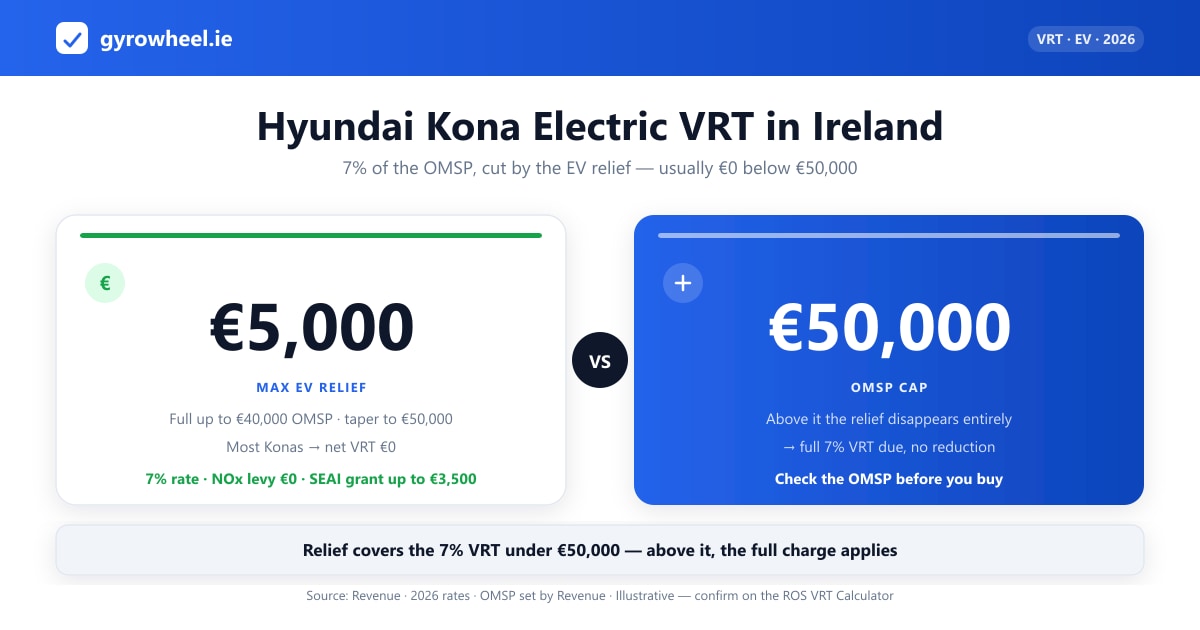
How the VRT relief works: OMSP and the €50,000 cap
The Kona Electric's VRT depends entirely on its OMSP: the relief reaches €5,000 up to €40,000, tapers between €40,000 and €50,000, and disappears completely above €50,000 (Revenue, 2026). Now that VRT is clearly "charged then reduced", everything turns on a single figure.
What is the OMSP and how does Revenue set it?
The Open Market Selling Price is the price Revenue considers the car would sell for retail in Ireland, including all taxes — not the price you paid or the dealer's invoice. Revenue maintains its own valuations, so a cheap private purchase does not lower your OMSP. The relief and the €50,000 cap are both measured against the OMSP, and the relief is applied automatically at registration — you do not file a separate claim (Revenue/ROS).
The three relief bands for an electric Kona
Once you know the OMSP, the relief follows three clear bands, set out below for a Kona Electric taxed at the 7% rate.
| OMSP band | VRT rate | Relief applicable | Estimated net VRT |
|---|---|---|---|
| ≤ €40,000 | 7% | Up to €5,000 (full) | Often €0 |
| €40,000 – €50,000 | 7% | Tapered (partial) | Usually €0, possibly partial |
| > €50,000 | 7% | None | Full 7% VRT due |
An affordable Kona Electric almost always lands in the first two bands, where the relief swallows the 7% charge and the net VRT is €0.
How much VRT will you pay on a Hyundai Kona Electric? Worked example
For a Hyundai Kona Electric with an illustrative OMSP of €36,975, the VRT at 7% would be about €2,588 — but the €5,000 relief absorbs it entirely, leaving €0 to pay. The bands become far clearer applied to a real Kona, so here are two variants worked end to end. (OMSP figures are illustrative; only Revenue's valuation is binding.)
Scenario 1 — Kona Electric Standard Range, OMSP under €40,000
Take a Kona Electric Standard Range with an estimated OMSP of €36,975 (a price observed on Carzone Ireland, 2026 — illustrative).
- OMSP: €36,975 (Revenue valuation, illustrative — not your invoice).
- VRT at 7%: €36,975 × 7% = €2,588.
- NOx levy: €0 (battery electric, no NOx emissions).
- Apply relief: up to €5,000 available, which fully covers the €2,588.
- Net VRT payable: €0.
Scenario 2 — Kona Electric Long Range, OMSP near the cap
Now take a Kona Electric Long Range 65 kWh with an estimated OMSP of €44,995 (a list price indicated for the Irish market, deenergyhub.ie — illustrative).
- OMSP: €44,995.
- VRT at 7%: €44,995 × 7% = €3,150.
- NOx levy: €0.
- Apply relief: the relief tapers in the €40,000–€50,000 band but still comfortably exceeds €3,150.
- Net VRT payable: €0.
| Variant (illustrative OMSP) | VRT at 7% | Relief | Net VRT |
|---|---|---|---|
| Standard Range (€36,975) | €2,588 | up to €5,000 | €0 |
| Long Range 65 kWh (€44,995) | €3,150 | tapered | €0 |
| Used near the cap (€50,450) | €3,532 | none above €50,000 | €3,532 |
A used Kona Electric listed above €50,000 — like a 2019 example seen at €50,450 (Kearys Hyundai Midleton) — loses the relief entirely and pays the full 7%. For the full picture on VRT for electric cars in Ireland, see our guide, and confirm your figure on the ROS VRT Calculator before you commit.
Importing a Hyundai Kona Electric: VAT and the Northern Ireland route
Importing a Kona Electric from Great Britain adds 23% VAT and import duty on top of any VRT, whereas a compliant car from Northern Ireland carries no duty and is only liable for VAT if it is under 6 months old or under 6,000 km (Revenue / Complete Car). Those new-car figures assume you buy in Ireland — but many Kona Electrics arrive as imports, and the origin changes the total bill far more than the VRT itself.
The VRT relief still applies as normal to an import, but it does nothing to offset the VAT. On a typical Kona, that VAT alone can add around €4,000–€5,000 when the car is under six months old, even if VAT was already paid abroad (Complete Car). A used Kona Electric already in free circulation in Northern Ireland that comfortably clears both the 6-month and 6,000 km limits avoids both duty and VAT, leaving only the (usually relieved) VRT — which is why the Northern Ireland route is frequently the cheaper way into the Irish market.
Registering your Kona Electric: the ROS calculator and the 30-day deadline
You must register an imported Hyundai Kona Electric within 30 days of its arrival in Ireland at an NCTS appointment, after estimating the amount on Revenue's official ROS VRT Calculator (Revenue / NCTS). The calculator draws on Revenue's own OMSP valuations and applies the EV relief automatically, so its output is your realistic working budget rather than the raw 7% charge.
- Estimate the VRT on the ROS VRT Calculator from your vehicle's details.
- Book an examination appointment with the NCTS as soon as the car arrives in the State.
- Bring the vehicle for physical examination with proof of import and the vehicle papers.
- Complete registration and pay any VRT due — within 30 days of arrival.
Missing the 30-day window is what triggers penalties, so book the appointment early rather than waiting for paperwork to be perfect.
Frequently asked questions
Beyond the core calculation, a few recurring questions decide whether a specific Kona Electric is worth it. Here are quick answers to the points buyers ask most.
Is a used or imported Kona Electric treated differently for VRT?
No — the same EV relief and 7% rate apply to a used or imported Kona Electric as to a new one (Revenue). What changes is the OMSP: Revenue sets its own valuation for that specific vehicle's age and mileage, and your net VRT follows from that figure, not from what you paid abroad.
Can I claim the SEAI grant as well as the VRT relief?
Yes for an eligible new car. The SEAI Purchase Grant (up to €3,500) and the VRT relief are separate supports applied at different stages — the grant reduces the purchase price, the relief reduces the VRT (SEAI). A new Kona Electric under the price ceiling can benefit from both; check each scheme's current eligibility rules.
What if my Kona Electric's OMSP is above €50,000?
Above €50,000 the relief disappears and the full 7% VRT is due, so a high-spec or low-mileage Kona near the cap can owe a real bill. Before buying, get the exact OMSP for that precise variant and year on the ROS VRT Calculator rather than assuming the badge alone keeps you under €50,000.
Until when is the EV VRT relief available?
The EV VRT relief is not permanent: it has been extended to 31 December 2026 (Revenue — confirm before purchase). Timing your registration before that date secures the current €5,000 cap and tapering thresholds.
Published 16 June 2026 by the Gyrowheel editorial team. Verified against Revenue.ie published rules for 2026.