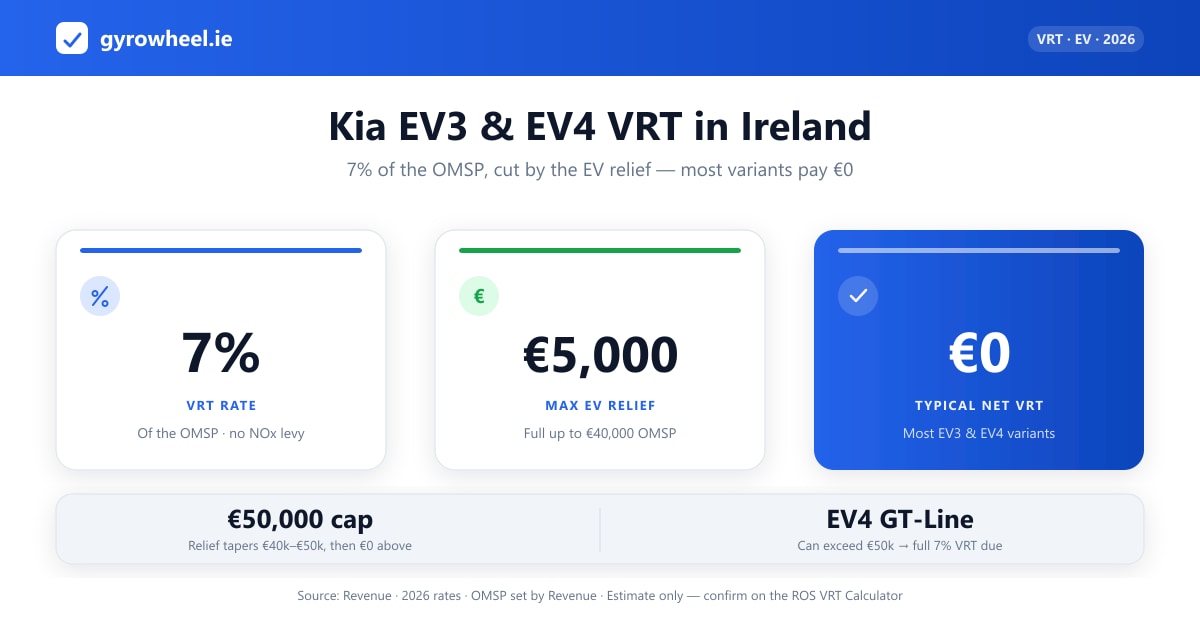
VRT applies to both the Kia EV3 and the Kia EV4 in Ireland, but as battery electric vehicles they sit in the lowest CO2 band and are charged at just 7% of the OMSP, pay a €0 NOx levy, and are then cut by an EV relief of up to €5,000 — so most versions of either car end up paying €0. The calculation is far simpler than for a petrol or diesel car, where CO2 and NOx both add to the bill.
This matters most when you are pricing a new EV3 or EV4, because a top-spec variant can quietly push its OMSP towards the €50,000 mark, where the relief tapers away and real VRT survives. Revenue (the Office of the Revenue Commissioners) sets the rates and is the final authority on the amount due. This guide turns the rule into a decision tool, with worked examples for both models and a clear EV3-versus-EV4 comparison.
Is there VRT on a Kia EV3 or EV4 in Ireland?
There is VRT on both the Kia EV3 and EV4, but it is a relief — not an exemption: Revenue charges 7% of the OMSP, adds €0 for NOx, then subtracts up to €5,000, which usually leaves €0 to pay (Revenue, 2026). The first myth to clear up is that electric cars are simply tax-free — they are not.
Relief, not exemption: the distinction that matters
The key distinction is that VRT is calculated, then reduced — not waived outright. Revenue treats a battery electric vehicle like any other car for the initial charge, applies the rate, and only then subtracts the EV relief (Revenue, 2026). For most affordable EV3 and EV4 variants the result is the same as an exemption (€0 owed), but the mechanism matters: if a car sits at the top of the price range, part of the VRT can survive the relief.
Calling EVs "exempt" is exactly the assumption that leads to a surprise at the NCTS. The correct framing is VRT relief, capped at €5,000, and it is this cap — not a blanket exemption — that decides whether a particular Kia pays anything at all.
Why an EV3 or EV4 is taxed at 7% with no NOx levy
The VRT rate on a Kia EV3 or EV4 is 7% of the OMSP, the lowest band in the system, because VRT for a passenger car is set by CO2 emissions and a battery electric vehicle emits none. With zero tailpipe CO2, both cars land in the bottom CO2 band, which carries the 7% rate.
The same zero-emissions logic removes the second component of VRT entirely. The NOx levy is charged on a car's nitrogen-oxide emissions, and a pure BEV like the EV3 or EV4 produces no NOx — so the NOx charge is €0 (Revenue). That makes the formula refreshingly short:
VRT = (OMSP × 7%) + €0 NOx − EV relief (up to €5,000)
Every figure below flows from that single line: take the OMSP, apply 7%, add nothing for NOx, then subtract the relief.
How the VRT relief works: OMSP and the €50,000 cap
The VRT you pay on an EV3 or EV4 depends entirely on its OMSP: the EV relief reaches €5,000 up to €40,000, tapers between €40,000 and €50,000, and disappears completely above €50,000 (Revenue, 2026). Because the bill is the 7% charge minus that relief, the whole calculation now turns on a single figure — the OMSP Revenue assigns to your car.
What is the OMSP and how does Revenue set it?
The Open Market Selling Price is the price Revenue considers the car would sell for retail in Ireland, including all taxes — not the price you actually paid or a configurator base figure. Revenue maintains its own valuations, so a cheap deal does not lower your OMSP, and adding options pushes it up.
This matters because the relief and the €50,000 cap are both measured against the OMSP, never against your invoice. The published Kia Ireland price list already shows figures net of the SEAI grant and VRT relief, so the catalogue number is not the OMSP — only the official valuation behind the ROS VRT Calculator tells you which band a specific Kia falls into.
The three relief bands for an electric Kia
Once you know the OMSP, the relief follows three clear bands. The structure is simple — full relief, tapered relief, or none — and the table below sets out what each means for a Kia taxed at the 7% rate.
| OMSP band | VRT rate | Relief applicable | Estimated net VRT |
|---|---|---|---|
| ≤ €40,000 | 7% | Up to €5,000 (full) | Often €0 |
| €40,000 – €50,000 | 7% | Tapered (partial) | Usually still €0, possibly partial |
| > €50,000 | 7% | None | Full 7% VRT due |
In practice, an affordable or mid-priced EV3 almost always lands in the first two bands, where the relief swallows the whole 7% charge and the net VRT is €0. Only a Kia whose OMSP climbs above €50,000 loses the relief entirely and pays the full 7% — which is why the variant you choose, not the badge, decides your bill.
How much VRT will you pay on a Kia EV3 or EV4? Worked examples
For a Kia EV3 Long Range with an illustrative OMSP of €40,000, the VRT at 7% would be about €2,800 — but the €5,000 relief absorbs it entirely, leaving €0 to pay; a top-spec EV4 above €50,000 OMSP, by contrast, loses the relief and owes the full 7%. The bands become far clearer applied to real cars, so here are both models worked from end to end. For a second opinion on the estimate, an Irish VRT calculator can confirm the OMSP-based figure. (The OMSP figures below are illustrative; only Revenue's valuation is binding.)
Scenario 1 — Kia EV3 Long Range, OMSP under €50,000
Take a Kia EV3 Long Range (81.4 kWh) with an estimated OMSP of €40,000. The calculation runs as follows:
- Step 1 — OMSP: €40,000 (Revenue valuation, illustrative — not the catalogue price).
- Step 2 — VRT at 7%: €40,000 × 7% = €2,800.
- Step 3 — NOx levy: €0 (battery electric, no NOx emissions).
- Step 4 — Apply relief: relief available is up to €5,000, which fully covers the €2,800.
- Step 5 — Net VRT payable: €0.
For context, the EV3 line starts at €36,791 for the Earth 2 Standard Range and runs to €47,190 for the GT-Line Long Range, both prices already net of the SEAI grant and VRT relief (Kia Ireland, 2026). Any EV3 valued comfortably below the €50,000 cap lands in the same place: the relief cancels the VRT.
Scenario 2 — Kia EV4 GT-Line, OMSP above €50,000
Above the cap the picture changes completely. Take a Kia EV4 GT-Line Long Range, the most expensive variant on the Irish list at €51,250 (Kia Ireland, 2026), with an estimated OMSP of €52,000. Because it exceeds the €50,000 threshold, no relief applies at all:
- Step 1 — OMSP: €52,000 (illustrative).
- Step 2 — VRT at 7%: €52,000 × 7% = €3,640.
- Step 3 — NOx levy: €0.
- Step 4 — Apply relief: none (OMSP over €50,000).
- Step 5 — Net VRT payable: €3,640.
The same 7% rate that costs nothing on a cheaper EV3 becomes a real four-figure bill on a top-spec EV4, purely because the OMSP crossed €50,000. This is the single most important thing to check before ordering the dearest variant.
EV3 vs EV4 VRT at a glance, by variant
The contrast across the two ranges is easiest to read in one place. The figures below pair the real Irish catalogue prices with illustrative OMSPs to show the mechanism — they are not Revenue valuations:
| Model & variant | Irish price (net) | Illustrative OMSP | VRT at 7% | Relief | Net VRT |
|---|---|---|---|---|---|
| EV3 Earth 2 Standard | €36,791 | €38,000 | €2,660 | up to €5,000 | €0 |
| EV3 Earth 2 Long Range | €40,350 | €41,000 | €2,870 | tapered | €0 |
| EV3 GT-Line Long Range | €47,190 | €48,000 | €3,360 | tapered | €0 (or small partial) |
| EV4 Earth 2 Standard | €39,940 | €41,000 | €2,870 | tapered | €0 |
| EV4 GT-Line Long Range | €51,250 | €52,000 | €3,640 | none | €3,640 |
Treat these as a guide to the pattern, then read up on electric car VRT in Ireland and confirm the exact figure for your configuration with the ROS VRT Calculator before you commit.
Kia EV3 vs Kia EV4: which costs more in VRT, and why
The Kia EV3 is the more affordable compact SUV and almost always lands in €0-VRT territory, while the larger, newer EV4 — especially the GT-Line — sits closer to the €50,000 cap where part of the relief, and therefore some VRT, can survive. With both calculations in hand, the practical question for a buyer is which model carries the lighter tax, and that comes down to where each one's OMSP falls relative to the cap.
The two cars share most of their engineering: both ride on the E-GMP platform with the same 150 kW (204 hp) single-motor FWD setup, and the same 58.3 kWh and 81.4 kWh batteries (Kia, 2025–2026). The differences that move the OMSP are size, body style and trim.
| Criterion | Kia EV3 | Kia EV4 |
|---|---|---|
| Segment / body | Compact SUV (~4.30 m) | C-segment hatch & Fastback (~4.43 m) |
| Irish price range | €36,791 – €47,190 | €39,940 – €51,250 |
| WLTP range (Long Range) | up to 605 km | up to 625 km (hatch), 630 km (Fastback) |
| Battery options | 58.3 kWh / 81.4 kWh | 58.3 kWh / 81.4 kWh |
| Position vs €50k cap | Stays below — €0 VRT | Top GT-Line can cross it |
Why the EV4 is more likely to pay some VRT
The EV4 is more likely to pay real VRT because it is larger and pitched higher in the range, so its OMSP sits nearer the €50,000 ceiling. The entire EV3 line tops out at €47,190, comfortably inside the relief zone, whereas the EV4 GT-Line is listed at €51,250 (Kia Ireland, 2026) — close enough that its Revenue OMSP can cross the cap and switch the relief off. If you want a guaranteed €0 registration tax, an EV3 or a mid-spec EV4 is the safer choice.
Stacking the SEAI grant with the VRT relief
The SEAI Purchase Grant (up to €3,500) and the VRT relief are separate supports with their own conditions, and both are already reflected in the effective price Kia Ireland publishes (Kia Ireland, 2026). The grant reduces the purchase price at the point of sale, while the relief reduces the VRT — they are applied at different stages. Because the catalogue figure is already "net customer", you should not deduct either support a second time when budgeting.
Registering your Kia EV3 or EV4: NCTS, the 30-day deadline and the ROS calculator
You must register a Kia EV3 or EV4 at an NCTS centre within 30 days of the car arriving in the State, after estimating the VRT on Revenue's official ROS VRT Calculator, which applies the EV relief automatically (Revenue, 2026). Once you know which band your chosen variant falls into, the NCTS appointment is the step that turns the estimate into a registered Irish car.
Step 1 — Estimate the VRT on the ROS calculator
Before booking anything, use the ROS VRT Calculator to get an estimate from your vehicle's details. It draws on Revenue's OMSP valuations and builds in the relief for eligible electric vehicles, so the output is your realistic working budget rather than the raw 7% charge. That makes it far more reliable than guessing from the catalogue price, which is already net of the SEAI grant and relief.
Step 2 — The NCTS appointment and the 30-day deadline
The registration itself follows a fixed sequence, and the clock starts the day the car lands:
- Book an examination appointment with the NCTS as soon as the car arrives in the State.
- Bring the vehicle for physical examination on the appointment date.
- Provide the supporting documents (proof of import, vehicle papers, identity).
- Complete registration and pay any VRT due — within 30 days of arrival.
Missing the 30-day window is what triggers penalties, so book the appointment early rather than waiting for paperwork to be perfect.
Frequently asked questions
The most common EV3 and EV4 questions cover the cars' range, the annual motor tax, the Euro NCAP score, and importing from Northern Ireland versus Great Britain. Beyond the VRT calculation itself, buyers consistently ask a handful of practical questions before committing — here are quick, direct answers.
What is the range of the Kia EV3 and EV4 in Ireland?
The Kia EV3 Long Range (81.4 kWh) is rated at up to 605 km WLTP, with the Standard Range (58.3 kWh) at up to 436 km (Kia, 2026). The EV4 goes slightly further thanks to its more aerodynamic body: up to 625 km for the hatchback and 630 km for the Fastback on the larger battery.
How much is the annual road tax on a Kia EV3?
The annual motor tax on a Kia EV3 is €120 a year, the flat rate Ireland applies to all battery electric vehicles regardless of variant. This is separate from the one-off VRT and is among the lowest road-tax bands available, which is one reason BEV running costs stay low year to year.
What is the Euro NCAP score for the Kia EV3?
The Kia EV3 holds a full 5-star Euro NCAP rating (2024), the maximum available. The result reflects strong adult and child occupant protection alongside its standard suite of driver-assistance systems, and it sits behind the EV3's recognition as World Car of the Year 2025.
Is it cheaper to import a Kia EV3 or EV4 from Northern Ireland?
Importing from Northern Ireland is usually cheaper: a car already in free circulation there carries no import duty, and VAT only applies if it qualifies as new (under 6 months old or under 6,000 km). A car from Great Britain is a third-country import, adding 10% duty and 23% VAT on top of any VRT (Revenue, 2025–2026). The EV relief applies either way, but it does nothing to offset VAT or duty.
Published 16 June 2026 by the Gyrowheel editorial team. Verified against Revenue.ie published rules for 2026.